
High Interest Savings Accounts in Singapore 2026: What 10 Accounts Actually Pay
We re-ran every bonus tier on one rule: it only counts if you can hold it forever without buying a financial product. On that basis the best sustainable savings rate is 2.20%, on one account, and only at S$100,000. Here is every account, condition and cap.
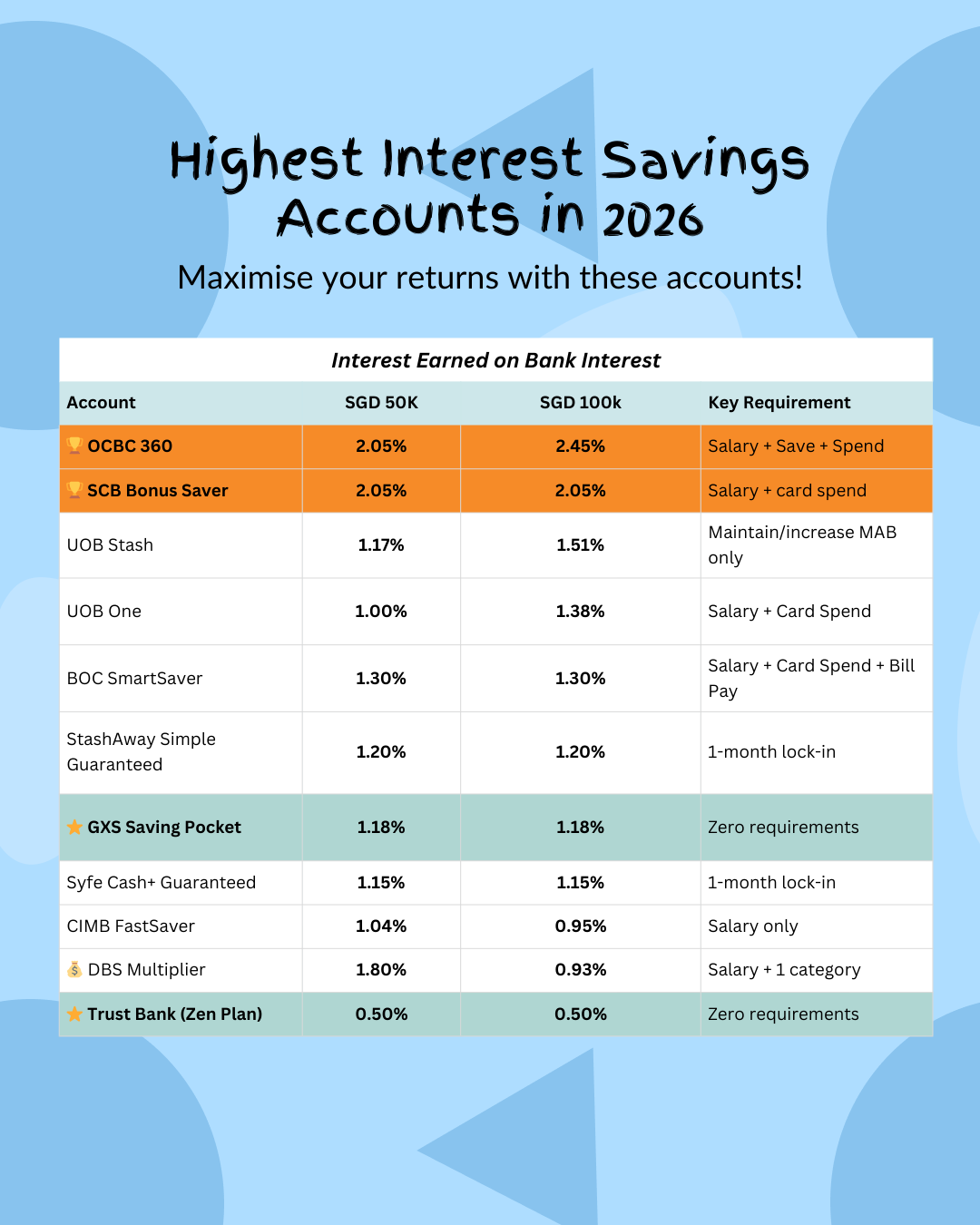
If you read this guide in January, it told you that a careful saver could get up to 3.55% p.a. on a Singapore savings account. This version says 2.20%, on one account, at a S$100,000 balance, and only while a promotion runs to 31 December 2026. (The standing rate underneath that promotion is 1.95%. We will come back to this repeatedly, because it is the single most caveated number in the article.)
Rates did fall. But most of that drop is not the market. It is us tightening our own rule, and we would rather show you the working than quietly restate a number and hope nobody notices.
The old rule was “exclude insurance and investment bonuses.” Reasonable, and we still exclude them. The problem is that it let a few other things through the net: promotional tiers that pay beautifully for six or twelve months and then stop, and “fresh funds” bonuses that require you to keep shovelling new money in month after month. Those are real rates. They are just not rates a fixed pile of savings can hold. If your S$100,000 is sitting in an account and you are not topping it up with new cash every month, a bonus that depends on new cash every month is not yours.
So here is the rule this guide now runs on, and it is the only rule that matters for everything below.

The One Rule: A Bonus Tier Only Counts If You Can Hold It Forever
A bonus tier counts toward our published rate only if a salaried person can sustain it indefinitely, without buying a financial product.
That is it. Everything else in this article follows from that sentence.
The dividing line it draws is between money you have to bring in from outside, or a product you have to buy, versus your own salary accumulating in place. The first is a promotional hoop. The second is just saving.
The clearest illustration: CIMB versus OCBC, and the 20x gap
Two accounts on this board pay you extra for your balance going up. They sound like the same condition. They are not remotely the same condition, and the difference is the whole methodology in one comparison.
OCBC 360’s Save bonus asks your average daily balance to rise by at least S$500 a month. If you earn a salary and do not spend all of it, that happens by itself. You are not performing a task for the bank. You are just not spending everything.
CIMB FastSaver’s fresh funds bonus asks for a S$10,000 month-on-month increase, measured against a baseline that resets every single month. So you add S$10,000 in month one. In month two the baseline moves up and you need another S$10,000 on top. Then another. Forever. Clause 4d of the promotion’s terms specifically bars you from re-using a prior increment to satisfy a later month.
That is 20 times the monthly inflow OCBC asks for, and unlike OCBC’s version it never stops asking. A parked sum cannot hold it. Someone earning a normal salary cannot hold it. Only someone actively pumping S$120,000 a year of new money into one savings account can hold it, and if you have S$120,000 a year spare you were never the person searching for savings rates.
One is saving. The other is feeding a promotion. We count the first and not the second.
What we exclude, and why
| Excluded tier | Why it fails the rule | The evidence |
|---|---|---|
| Insure or invest bonuses | Time-boxed and non-renewing. Holding the rate means buying a new product every window, forever. | 6 months per purchase at Standard Chartered and BOC (BOC cut its window from 12 months to 6 effective 1 Nov 2025); 12 months per purchase at OCBC and DBS |
| Fresh funds (CIMB) | Requires a S$10,000 month-on-month increase against a baseline that resets monthly, with clause 4d barring re-use of a prior increment. | CIMB CASA Bonus Interest Promotion T&Cs |
| Referral bonuses | You have a finite number of contacts. It runs out. | The Trust Bank scoop requires a newly approved referral each month |
What we keep, and why
We keep salary credit, card spend, bill payments, maintain-your-balance (UOB Stash) and balance growth (OCBC 360’s Save at S$500 a month, Trust’s Savings Increase at S$3,000 a month).
Balance growth is the one people argue about, so to be explicit: a salaried person does not spend their whole paycheck. The balance rises on its own. Treating ordinary saving as if it were a promotional hoop would be as silly as treating it as if it were free money.
One thing this article is not saying
The banks are not lying to you. Standard Chartered’s 5.85% is genuinely achievable. So is OCBC’s 4.70%, BOC’s 4.60% and DBS’s 4.10%. Walk into a branch, buy the qualifying product, hit every condition, and the bank will pay you exactly what the poster says.
The question this guide answers is narrower and, we think, more useful: what will a sum of money sitting in an account actually earn, year after year, without you buying anything? Those are two different questions with two very different answers, and the entire 1 to 3 percentage point gap between the poster and this article lives in that difference.

The Ten Accounts, Side By Side
All figures as of 1 August 2026. Two balance columns, because on several of these accounts the rate at S$50,000 and the rate at S$100,000 are not just different, they move in opposite directions.
The benchmark is Singapore CPI-All Items at 1.90% year on year (June 2026, released 23 July 2026). MAS Core inflation was 1.60%.
| Account | S$50,000 | S$100,000 | What it takes | vs CPI |
|---|---|---|---|---|
| OCBC 360 | 1.80% | 2.20% | Salary min S$1,800 + card spend min S$500 + grow balance min S$500/mo | above |
| Standard Chartered BonusSaver | 1.85% | 1.85% | Salary min S$3,000 + card spend min S$1,000 | below |
| BOC SmartSaver | 1.60% | 1.60% | Salary min S$3,000 + card spend min S$2,500 + 3 bill payments | below |
| UOB Stash | 1.17% | 1.51% | Keep monthly average balance at or above last month’s | below |
| UOB One | 1.00% | 1.38% | Salary credit min S$1,600 + card spend min S$500 | below |
| CIMB FastSaver | 1.54% | 1.29% | Salary min S$1,000 + card spend min S$800, on the first S$25k | below |
| GXS Saving Pocket | 1.08% | 1.07% | Nothing | below |
| Trust Bank (Flex plan) | 0.90% | 1.00% | Any 3 scoops from salary, card spend, balance growth, S$100k balance | below |
| DBS Multiplier | 1.80% | 0.93% | Salary credit + card spend, S$500 to S$15k monthly transactions | below |
| MariBank Save | 0.88% | 0.88% | Nothing | below |
The headline, scoped properly: 1 of these 10 savings accounts clears inflation, and only at S$100,000. At S$50,000, it is 0 of 10. The single account above the line is OCBC 360 at 2.20%, and that number comes with a condition we will not let out of our sight for the rest of this article.
The OCBC caveat, stated once here and repeated wherever the number appears: the 2.20% at S$100,000 (and 1.80% at S$50,000) includes a Save bonus promotion running 1 August to 31 December 2026, during which OCBC’s advertised maximum is 4.70%. The standing structure underneath it pays 1.70% at S$50,000 and 1.95% at S$100,000, with an advertised maximum of 4.45%. If you open the account in January 2026 and see 1.95%, that is the account working normally, not you being misled. The good news is that both versions clear CPI at S$100,000. The standing one clears it by five basis points, which is not a victory so much as a photo finish.
Advertised Maximum Versus What We Print
This is the table that explains the gap. Left column is what the bank puts on the poster. Middle is what we publish at S$100,000. Right is what got dropped in between.
| Account | Advertised max | We print (S$100k) | The dropped tiers |
|---|---|---|---|
| Standard Chartered BonusSaver | 5.85% | 1.85% | Invest +1.5pp, insure +2.5pp |
| OCBC 360 | 4.70% | 2.20% | Insure +1.25pp, invest +1.25pp |
| BOC SmartSaver | 4.60% | 1.60% | Wealth +3.0pp |
| DBS Multiplier | 4.10% | 0.93% | 2nd category via insurance or investment +2.3pp |
| CIMB FastSaver | 2.70% | 1.29% | Fresh funds +0.7pp (the S$10,000/month resetting increment) |
| Trust Bank (Flex plan) | 2.40% | 1.00% | Referral +1.2pp |
The Standard Chartered arithmetic, which we cannot improve on
Take the top row and do the subtraction.
5.85% advertised minus 1.85% sustainable equals a 4.00 percentage point gap.
Now look at what we removed to get there: +1.5pp for a six-month investment plan and +2.5pp for a six-month insurance policy.
1.5 + 2.5 = 4.00.
The gap is not a rounding difference, a fine-print technicality, or an argument about methodology. The gap IS the two products. Every basis point between the poster and the reality is the price of buying something, and it expires in six months, at which point you buy something again or watch the rate fall back.
That is the clearest thing on this entire board, and it is why we changed the rule.

The Floor: What Each Account Pays If You Clear Nothing At All
Worth knowing, because life happens. You change jobs and the salary credit stops for two months. You go travelling and the card spend falls short. Here is what the account drops to when you clear no conditions whatsoever.
| Account | Base rate with zero conditions met |
|---|---|
| GXS Saving Pocket | 1.08% |
| MariBank Save | 0.88% |
| BOC SmartSaver | 0.10% |
| OCBC 360 | 0.05% |
| Standard Chartered BonusSaver | 0.05% |
| UOB Stash | 0.05% |
| UOB One | 0.05% |
| Trust Bank (Flex plan) | 0.05% |
| DBS Multiplier | 0.05% |
Two accounts on this list pay their full published rate with no conditions at all: GXS Saving Pocket and MariBank Save. Their base rate is their rate. Everything else falls to 0.05% or 0.10%, which is to say roughly nothing.
That reframes the whole board. GXS at 1.08% is not competing with OCBC’s promotional 2.20% or its 1.95% standing rate. It is competing with OCBC’s 0.05%, which is what OCBC pays a month you do not clear the conditions. If your salary does not credit reliably, or you are between jobs, or the account is a genuine parked emergency fund with no activity attached to it, the base rate is the only number on the page that applies to you.
The Sharpest Thing In The Data: DBS 1.80% and OCBC 1.80%, Then They Diverge
If you take one thing from this article, take this.
At S$50,000, DBS Multiplier and OCBC 360 pay exactly the same rate: 1.80%. Same salary. Same card spend. Same money. Both hand you S$900 a year.
Now double the balance to S$100,000.
| Balance | OCBC 360 | DBS Multiplier |
|---|---|---|
| S$50,000 | 1.80% (S$900/yr) | 1.80% (S$900/yr) |
| S$100,000 | 2.20% (S$2,200/yr) | 0.93% (S$930/yr) |
OCBC’s 2.20% includes the Save bonus promotion running 1 August to 31 December 2026. The standing structure pays 1.70% at S$50,000 and 1.95% at S$100,000. The divergence below holds either way.
Same conditions, same deposit, opposite directions.
You put in a second S$50,000 at DBS and it earns you an extra S$30 a year. Thirty dollars. On fifty thousand dollars.
The reason is structural, not a trick. DBS Multiplier’s bonus interest on one qualifying category is capped at the first S$50,000. Clear salary plus one category and you get 1.80% on the first S$50,000 and the 0.05% base on everything above it. Blend those together across S$100,000 and you land at 0.93%. The second half of your money drags the average down until the whole account pays roughly half of what the first S$50,000 was paying.
OCBC 360 does the opposite. Its bonus tiers pay more on the portion of the balance above S$75,000, so the blended rate climbs as the balance grows, from 1.80% at S$50,000 to 2.20% at S$100,000, up to the S$100,000 cap.
The practical lesson is not “leave DBS.” It is that the balance band structure matters more than the headline rate, and almost nobody checks it. A rate quoted without a balance attached to it is not really a rate. It is why every table in this guide has two columns.
The GXS Ceiling: The One Account That Goes Backwards
GXS Saving Pocket is the other structural oddity, and it is the only row on the board where the rate at S$100,000 is lower than the rate at S$50,000.
GXS caps your Saving Pockets at S$95,000 in total, across all of them. So a S$100,000 balance cannot sit entirely in Saving Pockets. You get S$95,000 at the Saving Pocket rate of 1.08%, and the leftover S$5,000 sits in the GXS Main Account at 0.88%.
Blend those and you get 1.07%, fractionally below the 1.08% you would have had at S$50,000. Your money went up and your rate went down, by one basis point.
In dollar terms this is trivial: S$540 a year at S$50,000, S$1,070 at S$100,000. Nobody is being harmed. But it is a clean example of a cap doing something counterintuitive, and it tells you exactly where GXS wants to sit in your financial life: as a no-conditions account for balances comfortably under S$95,000, not as a home for a six-figure pile.
What Changed This Year
Conditions tightened almost everywhere in the past twelve months. This is not one bank trimming, it is the whole category.
- BOC SmartSaver cut its wealth bonus window from 12 months to 6 months, effective 1 November 2025, and dropped its base rate from 0.20% to 0.10%. Halving the window doubles how often you would need to buy a qualifying product to hold the advertised rate, which is precisely why the wealth tier does not survive our rule.
- MariBank Save went 1.88% to 1.28% to 0.88% across the year. That is a rate that has more than halved, on an account whose entire proposition is that it has no conditions.
- Standard Chartered BonusSaver’s advertised maximum went 8.05% to 7.05% to 5.85%, with the latest cut effective 1 May 2026. Note that this is the advertised number falling, which tells you the product bonuses are being trimmed as well as the base ones.
- UOB One narrowed what counts as a salary credit, effective 1 April 2026. It is no longer enough for money to arrive from your employer. The transfer has to be tagged GIRO-SALA, FAST-SALA or PAYNOW SALA. If your employer pays you by ordinary bank transfer, that may quietly stop qualifying, and the first you hear about it is a smaller interest line at the end of the month. Worth a check.

1. OCBC 360
Official website: ocbc.com/personal-banking/deposits/360-savings-account
What it pays: 1.80% at S$50,000 (S$900/yr), 2.20% at S$100,000 (S$2,200/yr). Advertised maximum 4.70%.
The conditions that count
| Condition | Threshold | Counts toward our rate? |
|---|---|---|
| Base interest | Just hold the account | Yes, 0.05% |
| Salary | Credit at least S$1,800/month via GIRO, FAST or PayNow | Yes |
| Save | Grow average daily balance by at least S$500/month | Yes |
| Spend | At least S$500/month on an eligible OCBC credit card | Yes |
| Insure | Buy a qualifying insurance product | No, +1.25pp, 12 months per purchase |
| Invest | Buy a qualifying investment product | No, +1.25pp, 12 months per purchase |
Add the two excluded tiers back and you get the 4.70% on the poster. Take them away and you get 2.20%. The 2.50 percentage point difference is two products, renewed every twelve months, forever.
Caps and bands
Bonus interest applies to the first S$100,000 only. Anything above that earns the base rate. The tiering is what makes this account unusual: the bonus rates paid on the slice above S$75,000 are materially higher than the rates on the first S$75,000, which is why the blended rate rises from 1.80% to 2.20% as you go from S$50,000 to S$100,000. Most accounts on this board do the reverse.
The caveat, again
The 1.80% and 2.20% figures include the Save bonus promotion running 1 August to 31 December 2026. The standing structure pays 1.70% at S$50,000 and 1.95% at S$100,000 (advertised maximum 4.45%). Both clear CPI at S$100,000, the standing version by five basis points.
Who it suits: someone with a stable salary credit, an OCBC credit card they already use, a balance heading toward S$100,000, and the discipline to let the balance grow by S$500 a month. That is a specific person, and if it is you, this is the only savings account on the board currently above inflation. If it is not you, the account drops to 0.05% and there is nothing here.
2. Standard Chartered BonusSaver
Official website: sc.com/sg/save/current-accounts/bonussaver
What it pays: 1.85% at both S$50,000 and S$100,000 (S$925 and S$1,850 a year). Advertised maximum 5.85%.
The conditions that count
| Condition | Threshold | Counts toward our rate? |
|---|---|---|
| Base interest | Just hold the account | Yes, 0.05% |
| Salary | Credit at least S$3,000/month | Yes |
| Card spend | At least S$1,000/month on eligible cards | Yes |
| Invest | Six-month investment plan | No, +1.5pp |
| Insure | Six-month insurance policy | No, +2.5pp |
Base plus salary plus card spend gets you to 1.85%, flat across both balance levels, which is at least refreshingly simple. Then, as shown above, the two product tiers add exactly 4.00 percentage points to reach the advertised 5.85%.
What changed
The advertised maximum has fallen from 8.05% to 7.05% to 5.85%, the most recent cut effective 1 May 2026. If you opened this account on the strength of an old 7.05% or 8.05% figure, the product you signed up for is not the product you have now.
Note also that the salary threshold here (S$3,000) is among the highest on the board, and the card spend requirement (S$1,000 a month) is double OCBC’s. This is not an account for someone with a modest or irregular income.
Who it suits: a higher earner with genuinely heavy card usage who wants a flat rate that does not care about their balance. It is the second-best sustainable rate here and the most predictable, and it is still 5 basis points below inflation.
3. BOC SmartSaver
Official website: bankofchina.com/sg
What it pays: 1.60% at both S$50,000 and S$100,000 (S$800 and S$1,600 a year). Advertised maximum 4.60%.
The conditions that count
| Condition | Threshold | Counts toward our rate? |
|---|---|---|
| Base interest | Just hold the account | Yes, 0.10% |
| Salary crediting | At least S$3,000/month to a BOC account | Yes |
| Card spend | At least S$2,500/month on an eligible BOC card | Yes |
| Bill payments | 3 payments by GIRO or online per month | Yes |
| Wealth | Buy a qualifying wealth product | No, +3.0pp, 6-month window |
Three conditions to clear, and the card spend requirement of S$2,500 a month is the steepest on this entire board. Five times OCBC’s. Two and a half times Standard Chartered’s. That is a genuine S$30,000 a year through a specific credit card, which is a lot of qualifying spend to manufacture if it is not already how you live.
What changed
Two cuts, both effective 1 November 2025. The wealth bonus window halved from 12 months to 6 months, and the base rate dropped from 0.20% to 0.10%.
The window change is the interesting one. A +3.0 percentage point bonus for buying a wealth product is a big number, and it is the single largest excluded tier on the board. But at a 12-month window you would have needed to buy a product once a year to hold it. At a 6-month window you need to buy one twice a year, every year, indefinitely. That is a treadmill, not an interest rate, which is exactly the distinction this article is built on.
Who it suits: someone whose spending genuinely runs above S$2,500 a month on one card and who already banks with BOC. The rate is flat across balances, which makes it easy to plan around. For most people the card spend condition alone rules it out.
4. UOB Stash
Official website: uob.com.sg/personal/save/savings-accounts/stash-account.page
What it pays: 1.17% at S$50,000 (S$585/yr), 1.51% at S$100,000 (S$1,510/yr).
The conditions that count
One condition. Keep your monthly average balance at or above last month’s. No salary credit. No card spend. No bill payments. No product purchase, and therefore nothing to exclude.
The bands
| Balance band | Base | Bonus if MAB maintained or increased | Total |
|---|---|---|---|
| First S$10,000 | 0.05% | none | 0.05% |
| Next S$30,000 | 0.05% | 1.35% | 1.40% |
| Next S$30,000 | 0.05% | 1.55% | 1.60% |
| Next S$30,000 | 0.05% | 1.95% | 2.00% |
The first S$10,000 earns essentially nothing, which is why the blended rate at S$50,000 is only 1.17% despite the middle bands paying 1.40% and 1.60%. Push the balance to S$100,000 and the top band at 2.00% pulls the blend up to 1.51%. Like OCBC, this is an account that rewards a larger balance rather than punishing it.
Who it suits: the “I do not want to perform for my bank” saver. There is no salary requirement and no spending requirement, so a between-jobs saver, a freelancer with lumpy income, or someone who simply does not want their credit card usage dictated by an interest rate can still earn the full 1.51%. The condition is not to grow the balance, only not to shrink it, which is about as gentle as bonus conditions get. The trade is that 1.51% is well below inflation.
5. UOB One
Official website: uob.com.sg/personal/save/everyday-accounts/one-account.page
What it pays: 1.00% at S$50,000 (S$500/yr), 1.38% at S$100,000 (S$1,380/yr).
The conditions that count
| Condition | Threshold | Counts toward our rate? |
|---|---|---|
| Card spend | At least S$500/month on an eligible UOB card | Yes |
| Salary credit | At least S$1,600/month, correctly tagged | Yes |
The bands
| Balance band | Card spend + qualifying salary credit |
|---|---|
| First S$75,000 | 1.00% |
| Next S$50,000 | 2.50% |
| Next S$25,000 | 3.40% |
Everything above S$150,000 earns 0.05%. The band shape explains the whole account: the first S$75,000 is the dead weight, paying a flat 1.00%, and the good rates only start on money above it. At S$50,000 you are entirely inside the 1.00% band. At S$100,000 you have S$25,000 in the 2.50% band, which lifts the blend to 1.38%. This is an account designed for a six-figure balance and it is honest about that in its structure.
What changed, and check this one
Effective 1 April 2026, UOB narrowed what counts as a qualifying salary credit. The transfer now has to be tagged GIRO-SALA, FAST-SALA or PAYNOW SALA. Money arriving from your employer by a plain bank transfer, with no such tag, may no longer trigger the salary condition.
This is the sort of change that costs people money silently. Nothing bounces, nothing gets rejected, the money still arrives. The interest line just gets smaller. If you hold this account, look at what your employer’s transfer is actually tagged as before assuming you still qualify.
Who it suits: a UOB customer with a balance well past S$75,000 whose employer pays through a properly tagged channel. Below S$75,000 the account is paying 1.00%, which is beaten by two accounts on this board that ask for nothing at all.
6. CIMB FastSaver
Official website: cimb.com.sg/en/personal/banking-with-us/accounts/savings-accounts/cimb-fastsaver-account.html
What it pays: 1.54% at S$50,000 (S$770/yr), 1.29% at S$100,000 (S$1,290/yr). Advertised maximum 2.70%.
The conditions that count
| Condition | Threshold | Counts toward our rate? |
|---|---|---|
| Salary credit | At least S$1,000/month | Yes, on the first S$25,000 only |
| Card spend | At least S$800/month on a CIMB Visa Signature | Yes, on the first S$25,000 only |
| Fresh funds | S$10,000 month-on-month increase, baseline resets monthly | No, +0.7pp |
The salary threshold of S$1,000 a month is the lowest on the board by a distance, which makes the account unusually accessible for part-timers, students with an internship stipend, or anyone whose income would not clear Standard Chartered’s or BOC’s S$3,000 bar.
The bands, and why the rate falls
| Balance band | Rate with salary + card spend |
|---|---|
| First S$25,000 | 2.00% (0.50% base + 0.50% salary + 1.00% spend) |
| Next S$25,000 | 1.08% |
| S$50,000 to S$75,000 | 1.58% |
| Above S$75,000 | 0.50% |
The bonuses only reach the first S$25,000. That slice pays a genuinely good 2.00%, and then the account stops rewarding you. At S$50,000 the blend is 1.54%. Push to S$100,000 and the final S$25,000 lands in a 0.50% band, dragging the blend down to 1.29%.
CIMB is the second account on this board, after DBS, where doubling your balance lowers your rate. Different mechanism, same lesson.
The excluded tier, in detail
CIMB’s fresh funds bonus is the one we spent the top of this article on. It adds 0.70 percentage points to reach the advertised 2.70%, and it requires a S$10,000 month-on-month increase against a baseline that resets every month, with clause 4d of the promotion terms barring you from re-using a prior increment. That is S$120,000 of new money a year, every year, to hold a 0.70pp bonus on the first S$25,000. The arithmetic does not work for anybody, which is why we do not print it.
Who it suits: someone with roughly S$25,000 to S$50,000 to park and a modest salary. In that specific window it is one of the better accounts here, because the first S$25,000 does real work at 2.00%. Above S$75,000 it is one of the worst.
7. GXS Saving Pocket
Official website: gxs.com.sg/savings-account
What it pays: 1.08% at S$50,000 (S$540/yr), 1.07% at S$100,000 (S$1,070/yr).
The conditions that count
Nothing. No salary credit, no card spend, no minimum balance, no lock-in. The 1.08% is the base rate and the base rate is the whole rate, which is why GXS also appears near the top of the base rate table above.
The caps and the backwards step
Saving Pockets are capped at S$95,000 in total, across every Pocket you open. Money beyond that sits in the GXS Main Account at 0.88%. So a S$100,000 balance splits as S$95,000 at 1.08% plus S$5,000 at 0.88%, blending to 1.07%, one basis point below where you started at S$50,000.
Interest accrues daily. There is no lock-in on either the Pocket or the Main Account, so the money stays genuinely liquid.
Who it suits: an emergency fund. Genuinely. This is money you might need on a Tuesday, that you cannot promise to leave untouched, that has no salary or card spend attached to it. Every conditional account on this board pays 0.05% in a month you fail its conditions. GXS pays 1.08% in every month, including the bad ones, up to S$95,000. Compare it against the base rate column, not the headline column, and it looks very different.
One note on GXS promotional rates: the bank has run headline promotional figures well above 1.08%. Those are promotional, time-boxed and not something a parked sum holds, so they do not appear in this guide.
8. Trust Bank (Flex plan)
Official website: trustbank.sg/savings-account
What it pays: 0.90% at S$50,000 (S$450/yr), 1.00% at S$100,000 (S$1,000/yr). Advertised maximum 2.40%.
The conditions that count
Trust runs a “scoops” system: you pick a number of qualifying activities and each one adds to your rate. On the Flex plan our rate assumes any 3 scoops, drawn from:
| Scoop | Counts toward our rate? |
|---|---|
| Salary credit | Yes |
| Card spend | Yes |
| Savings increase (balance growth of S$3,000/month) | Yes |
| Holding a S$100,000 balance | Yes, but only if you have S$100,000 |
| Referral | No, +1.2pp |
The base rate underneath all of this is 0.05%.
This is also why the rate steps up between the two balance columns. At S$50,000 you can reach three scoops through salary, card spend and savings increase. At S$100,000 the balance scoop itself becomes available, which is what takes you from 0.90% to 1.00%.
The excluded tier
The referral scoop is worth +1.2 percentage points, and it requires a newly approved referral every month. Not a one-time referral that keeps paying. A new person, signed up and approved, month after month. Everyone has a finite number of friends who want a bank account, and the day you run out, the rate falls. That fails the sustainability test as clearly as any product purchase does.
We are quoting the Flex plan only. Trust’s other plans are excluded from this guide because our sources conflict on their current terms, and we would rather print one number we can stand behind than three we cannot.
Who it suits: an existing Trust customer already using the card and crediting salary, for whom the scoops are a natural consequence of how they bank rather than a set of tasks. As a rate on its own, 1.00% at S$100,000 does not justify moving money.
9. DBS Multiplier
Official website: dbs.com.sg/personal/deposits/bank-earn/multiplier
What it pays: 1.80% at S$50,000 (S$900/yr), 0.93% at S$100,000 (S$930/yr). Advertised maximum 4.10%.
The conditions that count
Multiplier prices on two axes at once: how many categories you transact in, and how much total monthly volume flows through the account.
| Monthly transaction volume | Salary + 1 category | Salary + 2 categories | Salary + 3 categories |
|---|---|---|---|
| S$500 to S$15,000 | 1.80% (first S$50k) | 2.10% (first S$100k) | 2.40% (first S$100k) |
| S$15,000 to S$30,000 | 1.90% (first S$50k) | 2.20% (first S$100k) | 2.50% (first S$100k) |
| Above S$30,000 | 2.20% (first S$50k) | 3.00% (first S$100k) | 4.10% (first S$100k) |
The categories are salary credit, card or PayLah spend, home loan repayment, insurance and investments.
We price the salary plus one category row at the S$500 to S$15,000 volume band, because that is what a salaried person with a DBS or POSB card can hold indefinitely. The second category, for most people without a DBS home loan, means insurance or investment, worth +2.3 percentage points at the top volume band and excluded here for the same reason as everywhere else.
The cap that changes everything
Look carefully at the bracketed notes in that table. Salary plus one category is capped at the first S$50,000. Two or three categories extend the cap to S$100,000.
That single line is why DBS pays the same 1.80% as OCBC at S$50,000 and then collapses to 0.93% at S$100,000, and why the second S$50,000 in a Multiplier account earns about S$30 a year. It is the sharpest structural artifact in this dataset and it is not hidden. It is right there in the table, in brackets, where nobody reads.
Who it suits: a DBS customer with a balance at or under S$50,000, where the account is joint-best on the board. Or someone who genuinely has a home loan with DBS, which is a second category that costs nothing extra and unlocks the S$100,000 cap. If you are holding S$100,000 in a Multiplier on one category, the structure is working against you and you should at least know it.
10. MariBank Save
Official website: maribank.sg/fees-rates
What it pays: 0.88% at both S$50,000 and S$100,000 (S$440 and S$880 a year).
The conditions that count
Nothing. Like GXS, the base rate is the rate. No salary, no card spend, no minimum, no lock-in, no tiering, no balance bands to catch you out.
What changed
This is the biggest single-account decline on the board. MariBank Save has gone 1.88% to 1.28% to 0.88% over the past year, which is a cut of a full percentage point on a product whose entire appeal was a decent no-conditions rate.
It is still a no-conditions rate, and 0.88% comfortably beats the 0.05% base you would earn at most of the banks above in a month you slip. But GXS now pays 1.08% on the same terms with the same absence of hoops, and 20 basis points on the same conditions is not a hard comparison to make.
MariBank has advertised a higher headline figure and has run a fixed deposit promotion. The promotion window ran 1 to 31 July 2026, has closed, was new-customer-only and was capped at 10,000 openers, so a parked sum earns it once rather than indefinitely. Neither appears in this guide.
Who it suits: a secondary no-conditions parking spot, particularly if you have already filled the S$95,000 of GXS Saving Pockets and want a second account on the same terms rather than one with hoops attached.

Where Deposit Insurance Ends
Every account in this article is a bank deposit, and every one of them sits inside Singapore Deposit Insurance Corporation cover, up to S$100,000 per depositor, per Scheme member. “Per Scheme member” means per bank, not per account, so three accounts at the same bank share one S$100,000 limit while two accounts at two different banks have S$100,000 each. For the fuller treatment, including what falls outside the cover entirely, such as the fund units behind cash management accounts and other projected-yield products, see our companion piece on where to park your cash in 2026.
Which Account Suits Whom
These are findings about fit, not recommendations. What is right for you depends on your income, your spending, your balance and how much administration you are willing to tolerate for a few basis points.
If you have a stable salary, a card you already spend on, and a balance near S$100,000: OCBC 360 is the only savings account on this board currently paying above inflation, at 2.20% under a promotion running to 31 December 2026, or 1.95% on the standing structure. That is the finding. Whether it is worth moving your banking relationship for is a different question, and one only you can answer.
If your income is high and your card spend is heavy: Standard Chartered BonusSaver at a flat 1.85% is the most predictable rate here. It does not care about your balance and it does not tier. It also demands S$3,000 of salary and S$1,000 of monthly card spend.
If you do not want conditions at all: GXS Saving Pocket at 1.08%, up to S$95,000, then MariBank Save at 0.88% for anything beyond. No salary credit, no spending targets, no month where you accidentally fall to 0.05% because you were on holiday. For an emergency fund, the reliability is worth more than the headline gap.
If your income is irregular but your balance is stable: UOB Stash at 1.51% on S$100,000 asks only that your monthly average balance does not fall. No salary, no card spend. It is the best rate available to someone who cannot promise a salary credit.
If your balance is at or under S$50,000: DBS Multiplier and OCBC 360 both pay 1.80%, the joint-best figure at that level. CIMB FastSaver at 1.54% is worth a look if your salary is modest, since its S$1,000 threshold is the lowest here and its first S$25,000 works hardest.
If your balance is over S$100,000: every account here caps out. Bonus interest stops at S$100,000 for most of them and S$150,000 for UOB One. Money above the cap earns the base rate, which is 0.05% almost everywhere. At that point the question stops being “which savings account” and starts being “which instrument,” and that is a different article.
The Wider Board
Savings accounts are one row of a much bigger table. Treasury bills, Singapore Savings Bonds, fixed deposits and cash management accounts all compete for the same parked cash, and several of them currently pay more than every account in this guide.
We ran the full cross-category comparison, including the year-on-year moves and what the macro picture is doing to all of it, in our companion piece on where to park your cash in 2026. If you are deciding between a savings account and something else entirely, start there and come back here for the account-level detail.

The Takeaway
Ten savings accounts. One of them clears inflation, and only at S$100,000. At S$50,000 it is none of them.
That is a bleaker sentence than the one this guide opened with in January, and the honest reason is split between two things. Rates did come down. But the bigger cause is that we stopped counting bonus tiers that a parked sum cannot hold, and once you apply that rule consistently, a lot of impressive-looking numbers turn out to have expiry dates attached.
Three things worth carrying away:
The gap between the poster and reality is usually a product. Standard Chartered’s is the cleanest demonstration: 5.85% minus 1.85% is 4.00 percentage points, and the two dropped tiers are +1.5pp for an investment plan and +2.5pp for an insurance policy, which sum to exactly 4.00. The gap is not fine print. It is the two products, renewable every six months.
The balance band matters more than the headline. DBS and OCBC both pay 1.80% at S$50,000. At S$100,000 one pays 2.20% (1.95% once OCBC’s Save promotion ends on 31 December 2026) and the other 0.93%, and nothing about the conditions changed. Never accept a rate quoted without a balance attached to it.
Check the base rate, not just the bonus rate. Most of these accounts pay 0.05% in a month you miss a condition. Two of them pay their full rate unconditionally. Which of those matters to you depends entirely on how reliable your salary credit and card spend actually are, and most people are more optimistic about that than their bank statements justify.
All rates in this article are as of 1 August 2026, sourced and cross-checked as listed below. This is factual reporting on published rates, not a recommendation to open, close or move any account. Rates and conditions change frequently, and several of the accounts here changed within the past twelve months. Verify with the bank before acting.
How we sourced this
Every figure here comes from a dated snapshot verified before publication. Each of the ten savings accounts is double-sourced: the bank’s own published rate page, read on 1 August 2026, plus an independent Singapore review or rate notice tracking the same product. The inflation benchmark is SingStat’s June 2026 CPI release, and the deposit insurance limit comes from SDIC and MoneySense. Each of those sources is linked inline, at the point where the number it backs appears. Two documents are cited in the text without links because they are not stable public pages: the CIMB CASA Bonus Interest Promotion terms and conditions, and Standard Chartered’s 1 May 2026 revision notice. All rates as of 1 August 2026.
Not sure which of these fits your situation? Get personalised guidance from a financial professional. Book your free consultation today!